1936
In a change from previous years, the 1936 model year started in November 1935 rather than January 1st. This was to help with the fall season when sales and production generally took a slump; the new models provided a boost in sales during an otherwise slow time. Even considering that the 1935 sales year was cut two months short, DeSoto sales were still up 54% and maintained thirteenth place in the market. Some of that sales increase can be attributed to the start of the recovery from the Depression.
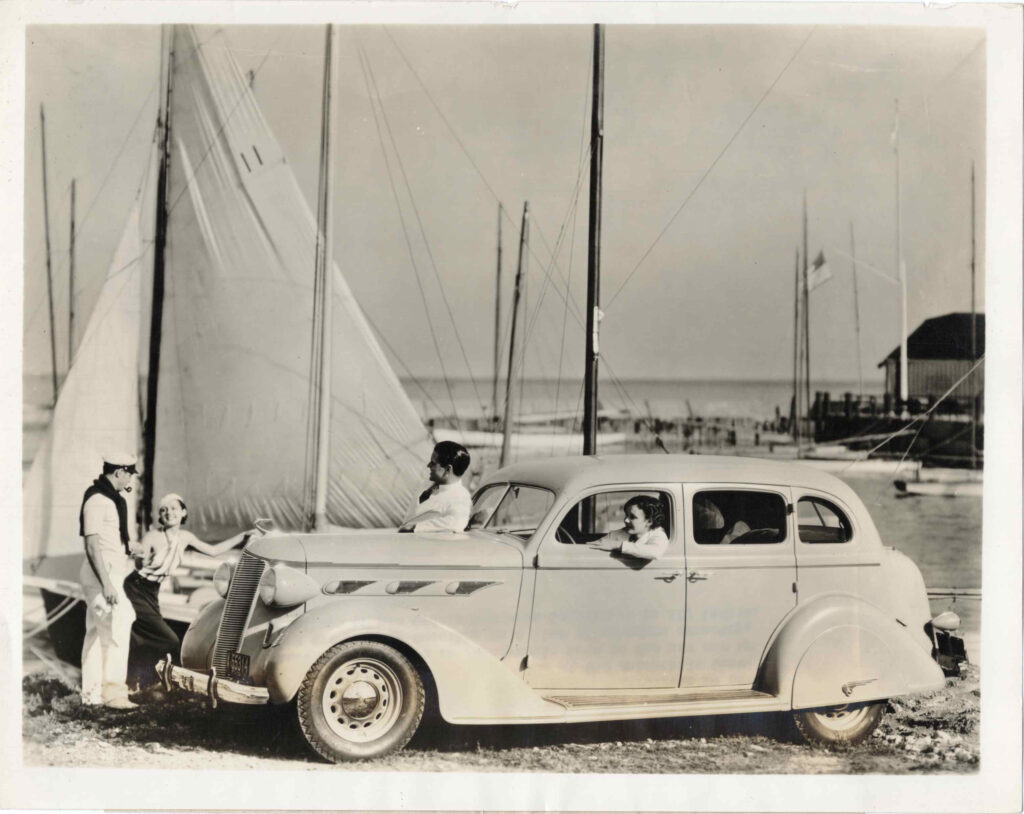
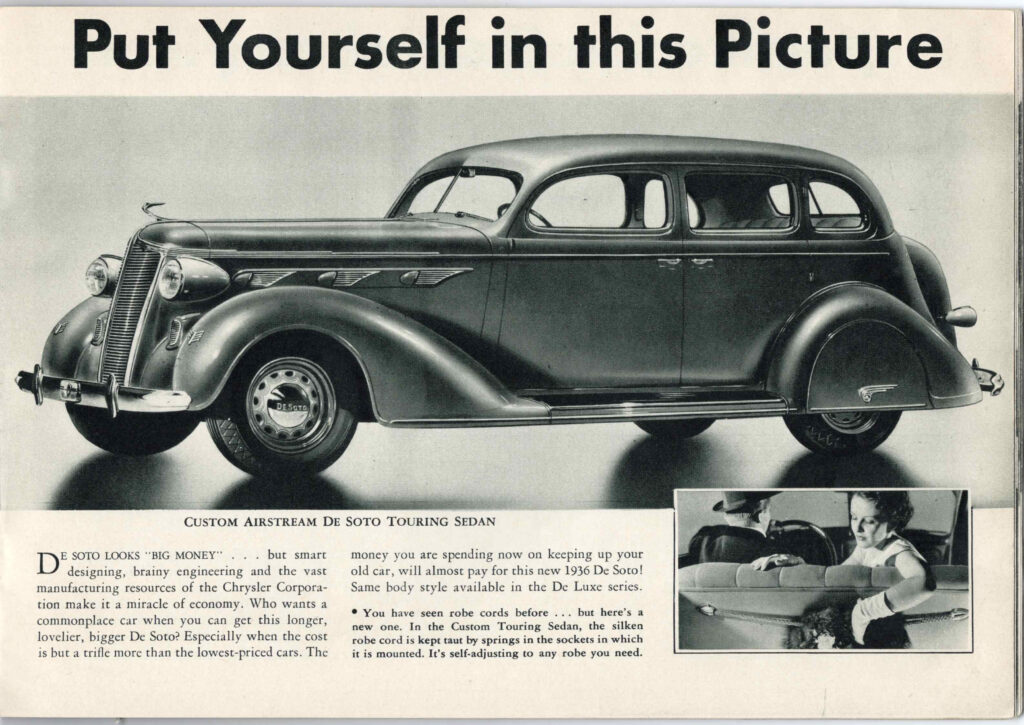
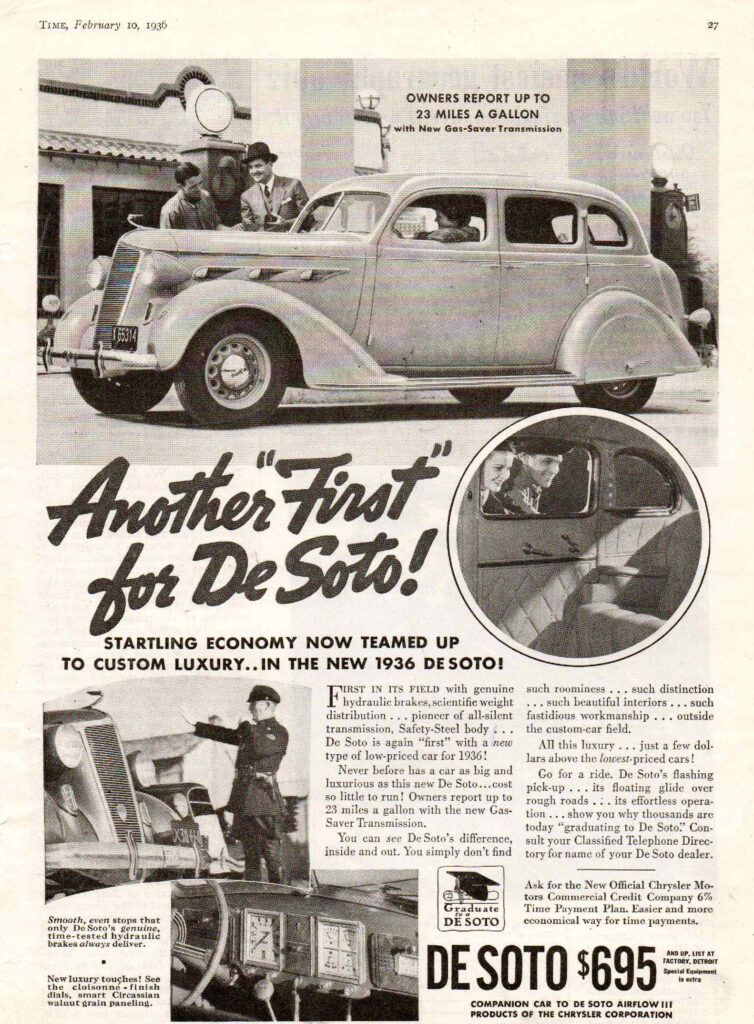
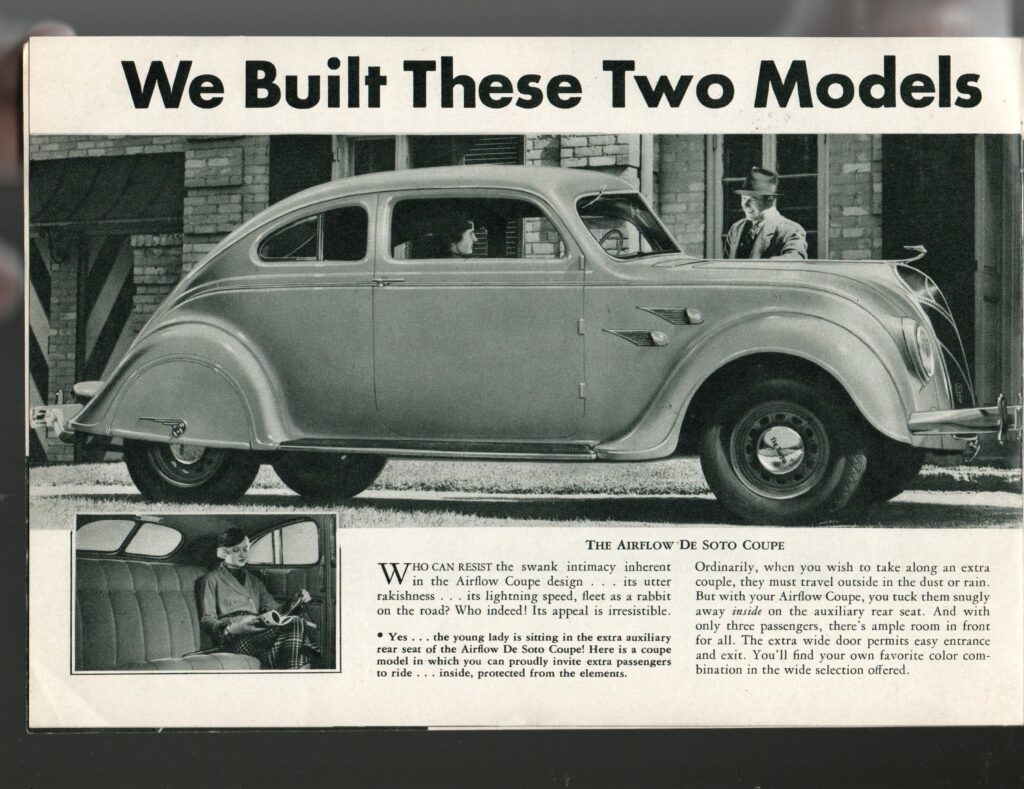
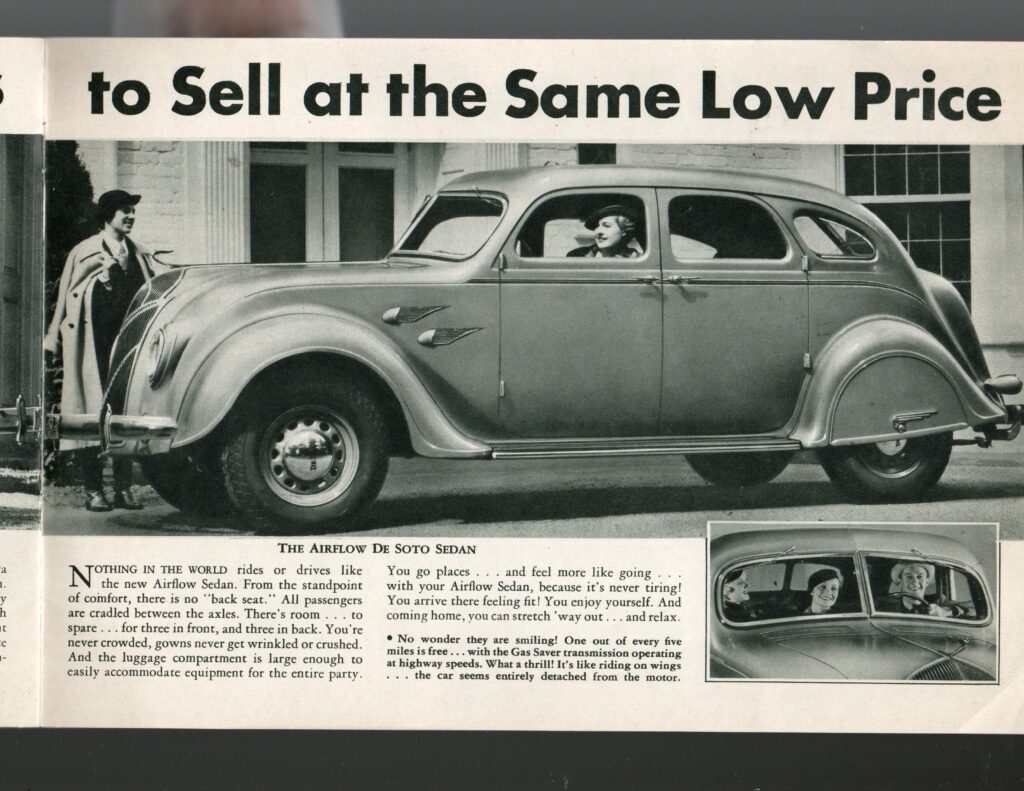
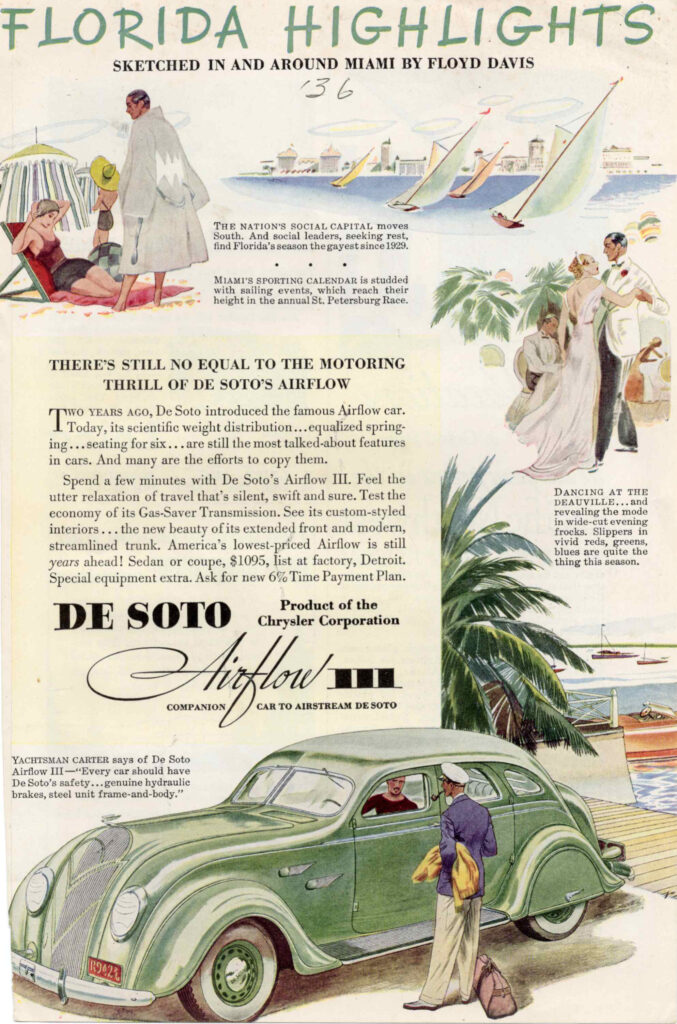
The 1936 DeSoto was available in three models: the S-1 Airstream, available as a DeLuxe or Custom, and the S-2 Airflow, also known as the “Airflow III”. This final iteration of the Airflow for DeSoto (Chrysler Division would still produce an Airflow in 1937), was reduced to just two body styles, a coupe and a sedan. Under the body, not much was changed, retaining the previous 100 hp 6-cylinder engine and 115.5-inch wheelbase. A new instrument panel and yearly re-design of the seats and door panels were accompanied by minor external changes, including a new diecast grille, tail lamps, side louvers and moldings, bumpers, and the integration of the spare tire within the body on the sedans. Just 5,000 DeSoto Airflows were made for the 1936 model year.
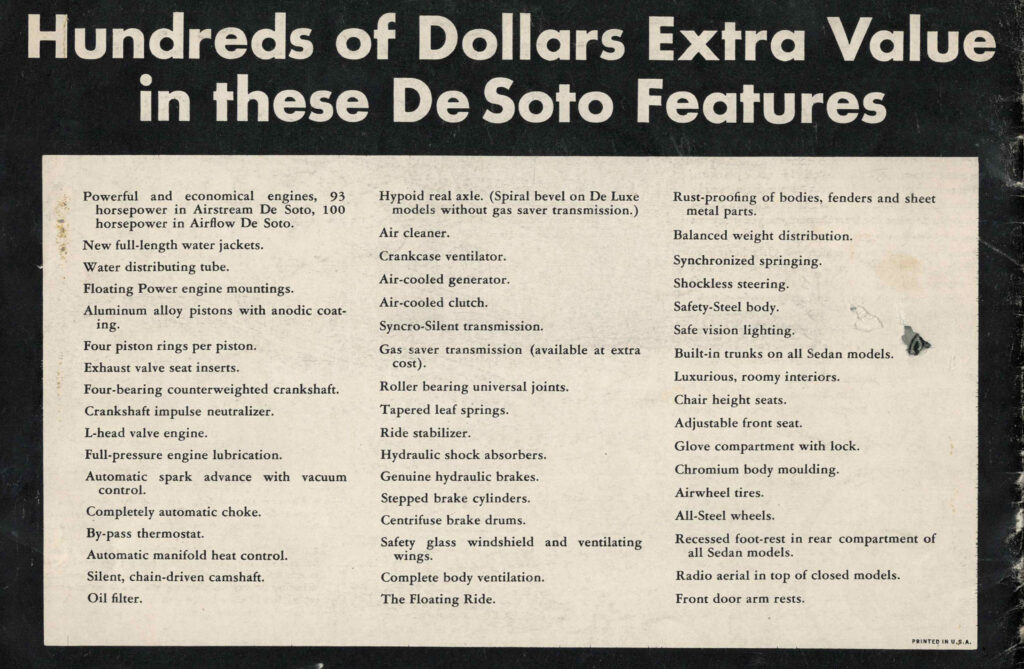
As DeSoto was sunsetting the Airflow, design and engineering changes were focused on the successful Airstream model. A whole slew of body types (see “Production Numbers” list) were available. The standard chassis cars rode one inch lower and had a one inch longer wheelbase than in 1935, bringing the wheelbase to 117 inches. These Airstreams were powered by a 93 hp 6-cylinder engine on Floating Power mountings, backed by a helical-gear manual transmission and (new) optional overdrive with hypoid rear axle. For the larger cars, such as the 7-passenger sedan, Traveler, and Limousine, a new 130-inch wheelbase was used, along with a 100 hp version of the 6-cylinder engine.
The new Chief of Design was Ray Dietrich, coming from a background of custom coach-built bodies. Like the Airflow, the 4-door sedans (and Touring Broughams) had the spare tire housed within the trunk compartment. Distinguishing the DeLuxe from the Custom was relatively easy; DeLuxe cars had a one-piece windshield while Customs had a two-piece windshield, though the one-piece flat windshield was used for both Custom convertible bodies (there were no DeLuxe convertibles). The one-piece windshield was crank-operated (the two-piece version was not) and was accompanied by sliding door glass and pivoting quarter windows on the 4-doors. Customs were further recognizable by chrome moldings on the headlamps, chrome chevrons on the front fenders, fender skirt bottoms, rear wheel shields, and running boards. Spare tires could also be mounted in the front fender wells.
For both models, there were distinctive horn housings below the headlamps, and the grille emblem was located in two locations during the year; it started out located down low in the grille and by early spring it was moved to the mid-to-upper portion of the grille. On the interior, adjustable chair-height seats were a welcome addition, accompanied by contoured armrests, assist loops, pleated door trim panels, silken robe cord, carpeted footrest, walnut paneling, and Bedford cord or mohair upholstery.
As the 1936 calendar year came to a close, Chrysler Corporation would move DeSoto production to a dedicated facility for the following model year.
For more information regarding the Airflow, visit the Airflow Club of America website.
Engine: 241.5 c.i. 6 cylinder; 93 hp standard, 100 hp w/optional head, long wheelbase Airstreams, and all Airflows.
Wheelbase: Standard Airstream = 117 inches, 7+ passenger Airstream = 130 inches, Airflow = 115.5 inches
Serial Numbers
DeLuxe Airstream (Detroit): 6043701 - 6061693
DeLuxe Airstream (Windsor): 9699076 - Not Available
Custom Airstream (Detroit): 5500001 - 5517216
Custom Airstream (Windsor): 9664641 - 9665550
Taxi (Detroit): 5997501 - 6000000, 6004101 - 6004200
Airflow (Detroit): 5089001 - 5093971
Airflow (Windsor): 9603551 - 9603582
Source: July 1973 Chrysler Corporation Letter
Production Numbers
DeLuxe Airstream Business Coupe: 2,592
DeLuxe Airstream Touring Brougham: 2,207
DeLuxe Airstream Touring Sedan: 13,093
Custom Airstream Rumble Seat Coupe: 641
Custom Airsteram Business Coupe: 940
Custom Airstream Touring Brougham: 1,120
Custom Airstream Touring Sedan: 13,801
Custom Airstream Convertible Sedan: 215
Custom Airstream Convertible Coupe: 350
Custom Airstream 7-Passenger Sedan: 208
Custom Airstream Traveler: 23
Custom Airstream Limousine: 10
Custom Airstream Chassis: 460
Custom Airstream Taxis: 2,951
Airflow Sedan: 4,750
Airflow Coupe: 250
Source: The Plymouth and DeSoto Story by Don Butler